Seven out of ten hiring managers will tell you the same thing — qualified candidates are hard to find. Not applications but qualified candidates.
Did you know that in just 2025, a single job post on any platform attracted an average of 242 applications? And somewhere in that pile, the right candidate is waiting. The question is whether your process finds them before they accept an offer somewhere else.
Despite all the flood of candidates, the hiring process hasn’t kept up as time-to-fill has jumped by 42% in just two years. At the same time, SHRM estimates the average cost per hire is $4,700, and that number climbs significantly for technical or executive roles.
So here’s the real question… Why are we still relying on humans to review resumes manually, and that too in 2026?
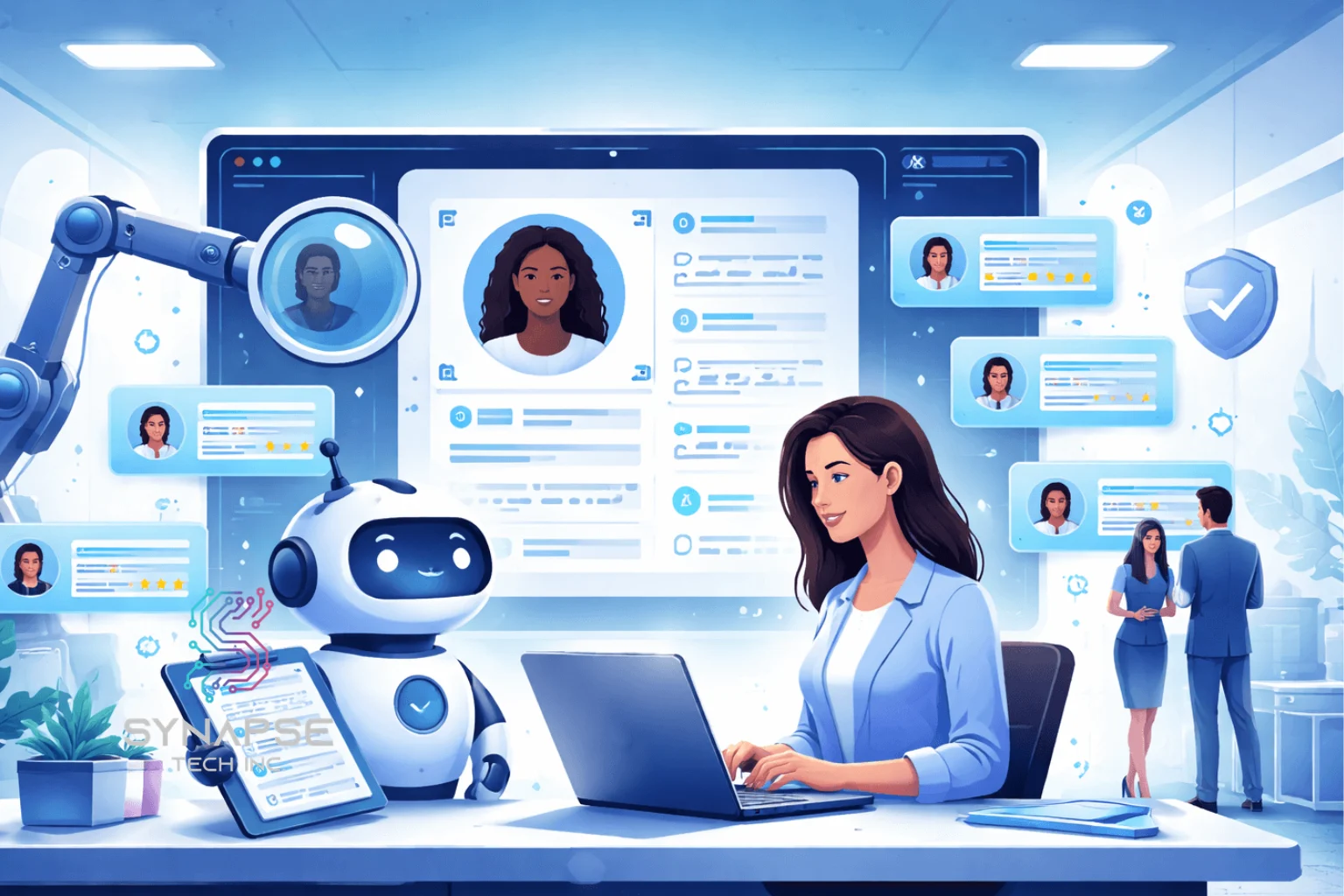
That is exactly where an AI recruiting assistant has become a strategic necessity.
A company leading this shift is Synapse Tech Inc., by embedding an intelligent, AI-powered platform directly into business operations.
Why Every Business Needs an AI Recruiting Assistant?
Let’s be honest. Hiring, these days, has become operationally messy.
Time to hire stretches way longer than needed, and as a result, candidates ghost the company. Thats not all, a lot of times, even managers can’t agree on scoring and by the time decisions are made, top talent has already signed elsewhere.
It‘s proven by research that hiring speed directly impacts candidate acceptance rates. When there are slow processes, they end up reducing competitive advantage.
Meanwhile, Harvard Business Review has repeatedly highlighted that structured interviews are more predictive of job performance than unstructured ones. And the best part is that AI recruiting assistants bring structure into what has traditionally been subjective.
They help with:
- Faster resume screening
- Standardized evaluation criteria
- Automated interview scheduling
- Funnel analytics visibility
- Reduced inconsistency across reviewers
And here’s something most teams do not track properly. Recruitment inefficiency rarely shows up clearly in financial statements. It shows up in delayed product launches, understaffed teams, lost revenue momentum, and burnout.
Why Companies Are Adopting AI Recruiting Assistants?
AI in HR is no longer experimental, as a recent survey shows that organizations adopting AI across business functions report measurable efficiency, including 67% faster screening cycles, 25%-35% decrease in drop-off rates, and higher quality shortlists.
What makes this shift powerful is not just cost reduction… it is scalability.
Manual hiring has a ceiling, and of course, recruiters can only review so many applications per day. Whereas an AI system does not know fatigue, nor do they inconsistently score based on mood or workload.
Now let’s talk about infrastructure quality…
Some AI recruiting assistants operate simply as advanced keyword filters. They look impressive, but they are surface-level automation. However, an intelligent AI-driven system operates on semantic intelligence, meaning the evaluation of skill context using embedding-based analysis.
Besides this, an intelligent solution helps the hiring team achieve bias-free scoring of candidates, voice-enabled structured interviews, API-first integration with ATS platforms, and full audit trails for compliance.
A quick trade-off:
| Improvement | Typical Impact | Key Risk |
| Time to shortlist | −50% to −70% hours for sourcers | Over-reliance on opaque scores |
| Candidate reach | +20% passive candidate discovery | Privacy and consent gaps |
| Interview throughput | +2–4x interviews per week | Poor candidate experience if impersonal |
| Predictive screening | Better early-fit signals | Biased training data → unfair rejections |
Key Benefits of Using an AI Recruiting Assistant
When you move away from standalone tools and toward a truly intelligent hiring platform, you’re essentially breaking down the silos that usually trap talent data. It doesn’t just scan for keywords, but it also eliminates the first-round blind spot” by evaluating a candidate’s actual context, intent, and skill set. This ensures that high-potential talent isn’t accidentally screened out by a human.
A retail group running seasonal hiring campaigns was processing thousands of applications across multiple locations with a lean HR team. Manual coordination was creating delays, and candidate drop-off was high.
By shifting to an AI-powered and data-driven model, it slashed its hiring costs by 30–35%, drop-off reduced by 38%, and the team was able to manage three times the volume without adding headcount.
One HR director put it plainly: “We weren’t bad at hiring before. We were just spending most of our time on the parts that didn’t need us. That’s what changed.”
How AI Recruiting Assistants Improve Hiring Speed and Talent Quality?
Open roles cost more than most leaders account for… not just in lost productivity — but in the candidates who moved on while the process was still catching up. Firms that ignore this shift are stuck with 67-day hiring cycles and are way behind the curve. Whereas their competitors are hiring within 48 hours.
If your organization is scaling, competing for talent, or struggling with hiring inconsistency, it may be time to explore structured AI recruitment.
Contact Synapse Tech Inc. to understand how intelligent hiring systems and solutions like iRecruit One can support your growth before your competitors secure the candidates you were still reviewing. When you contact Synapse Tech Inc., you’re not handed off to junior reps. You connect with people who think in AI-powered solutions, outcomes, and long-term value.
Read More: AI Powered Agency: Why Modern Brands Are Switching in 2026?
FAQs About AI Recruiting Assistants
Why is AI good for recruitment?
Because the volume of applications today is too high for any manual process to handle well. An AI recruitment assistant is intelligent and doesn’t miss patterns when the workload is high or screen out qualified candidates because a keyword didn’t match.
What is my purpose as an AI assistant?
In hiring, an AI recruiting assistant exists to take the heavy lifting off your team’s plate. It looks after the basic hiring process, including the initial screening, candidate evaluation, and interview scheduling. These are the parts that eat up hours without requiring much actual judgment.
Why do I want to work with AI?
Hiring teams are faced with more applications and higher expectations, but they have the same headcount. AI handles the volume without the organization having to grow the HR team every time hiring picks up. And done right, it also takes some of the unconscious bias out of early-stage decisions.
How to choose the right AI assistant?
The wrong question is which one has the most features. The right question is whether you can trust how it makes hiring decisions. An intelligent solution that is powered by semantic intelligence, does transparent scoring, and is easily integrated with existing ATS. Bias reduction and full auditability aren’t just nice-to-haves, and avoid black-box systems without explainability.