Imagine a logistics company that invested heavily in technology.
They have route optimization software. Warehouse automation tools. And a CRM for customer service.
Individually, everything works…
But when a shipment delay occurs, the operations team checks one system, the support team checks another, and finance pulls numbers from somewhere else. The thing is that the technology exists; however, there’s no visibility. And this is exactly where IT strategy consulting enters the conversation.
At its simplest, IT strategy consulting answers four questions:
What technology should drive the business?
How should systems integrate across departments?
Where can automation or AI remove operational friction?
When should companies modernize before growth slows down?
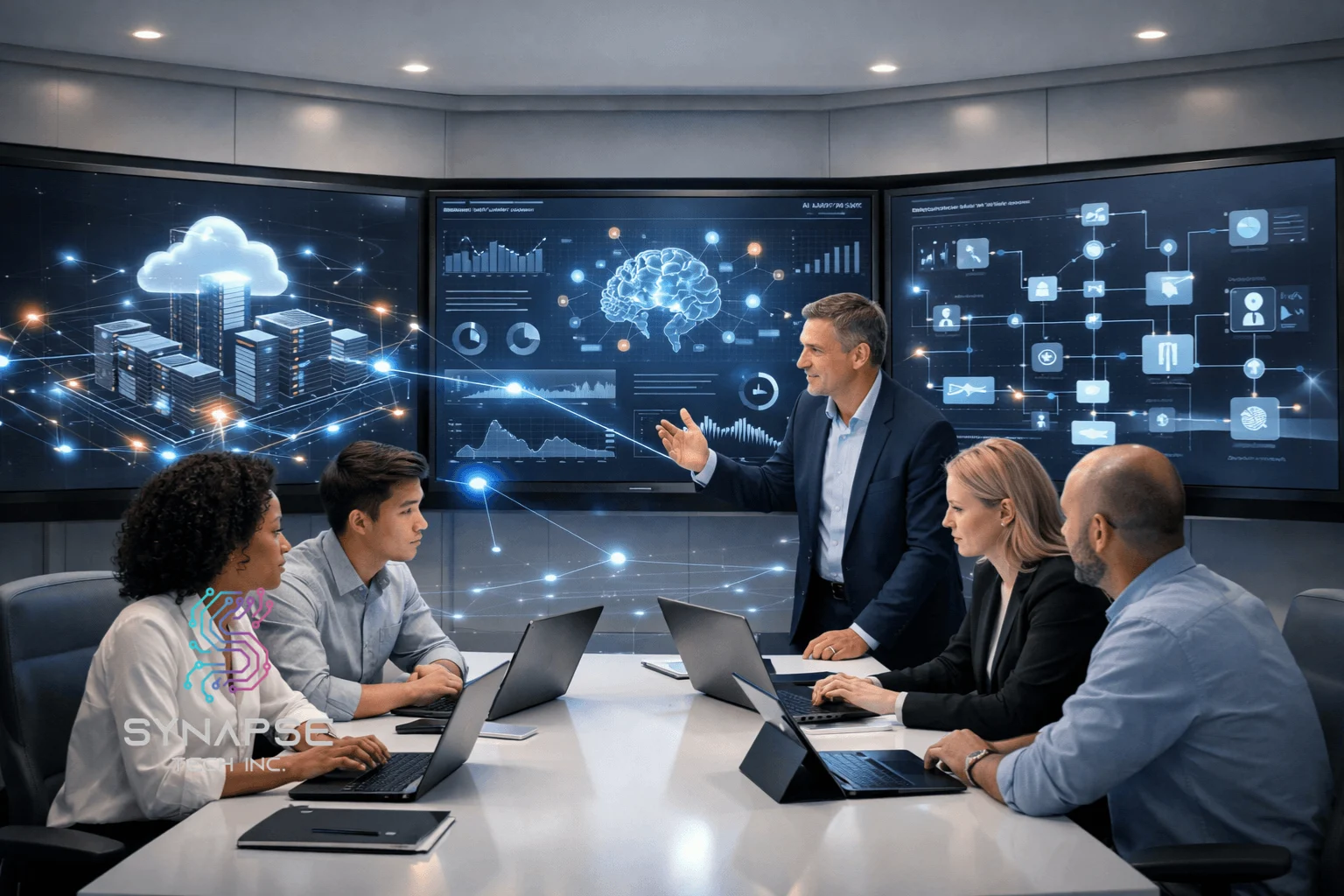
Instead of focusing on isolated tools, IT strategy consulting focuses on technology architecture. On a side note, companies like Synapse Tech Inc., a firm known for building AI-driven infrastructure directly into operational systems, are leaning heavily into this model. Rather than producing strategy decks, they design platforms that continue to work long after the consultants leave.
How IT Strategy Consulting Works in Modern Businesses?
Think about a growing company trying to scale its hiring.
Applications come through one system. Interview feedback sits in spreadsheets. HR analytics lives in another dashboard. Everything technically works — but the process is slow and fragmented.
This is where IT strategy consulting becomes practical.
Rather than adding another platform to the stack, the focus shifts to fixing how the existing systems interact. Recruitment data is brought into a shared cloud-based environment, routine coordination tasks are automated, and AI tools review hiring activity to highlight patterns leaders can use to make better decisions.
In some cases, voice agents and conversational AI handle routine candidate questions, while custom-built platforms connect recruiting, workforce analytics, and operational planning.
The pattern is consistent across all of the industries. The technology exists to fix the problem and the strategy to connect it properly, but it usually doesn’t happen.
How IT Strategy Consulting Connects Systems and Workflows? |
||
| Technology Layer | What It Solves | Example |
| Cloud Infrastructure | Centralizes data | Shared HR dashboards |
| Automation | Removes repetitive tasks | Interview scheduling |
| AI & Analytics | Detects patterns | Hiring pipeline insights |
| Custom Platforms | Connects workflows | HR + operations systems |
| Voice Agents | Handles communication | Candidate inquiries |
Why IT Strategy Consulting Is Growing in 2026?
Here’s a number that should give any leadership team pause. According to McKinsey’s 2025 Global Survey on AI, only 1% of organizations describe their AI rollouts as mature — despite 88% having adopted it in some form. So while most companies are already experimenting with AI and putting real money behind it, many still feel like the payoff hasn’t fully arrived.
Moreover, the numbers for 2026 are clear: The global technology consulting market is set to surpass $400 billion this year. This growth is fueled by a massive shift toward outcome-based consulting rather than simple project delivery.
Gartner’s 2025 CIO Survey found that 89% of board directors now list digital acceleration as a top priority — up from 69% just two years prior.
Another recent report found that organizations with a defined AI strategy were 2.5x more likely to report significant business outcomes. Yet a report found that 32% of cloud spend is wasted due to poor planning and misaligned architecture.
Within the framework of IT strategy consulting, the choice of infrastructure determines your speed. This is where Opira by Synapse Tech Inc. provides an unfair advantage to enterprises. While traditional consulting might lead to fragmented bolted-on tools, Opira offers a unified, intelligent foundation.
Why Industries Are Shifting Toward Intelligent IT Strategy Consulting?
Proof of concept is the only currency that matters in a high-tech market when it comes to IT strategy consulting advantages to different industries:
- The Global Logistics Win: A tier-1 logistics company was battling a 12% error rate within the last-mile delivery. After a strategic shift to an AI-powered autonomous consulting and routing system, errors dropped to under 2% in 4 months. “The ROI was visible within the first 60 days,” noted their CTO.
- The HR Transformation: “Our hiring cycle was 45 days. With custom AI voice agents handling first-round screening, we dropped that to 9 days,” shares Mark D., Head of Talent at a major tech firm. After a strategic audit identified the bottlenecks and a custom AI layer was built to connect the systems, time-to-hire dropped to 28 days within the first quarter. The HR team didn’t change but the infrastructure did. “We weren’t making bad decisions. We were making slow ones based on incomplete information. Fixing the strategy fixed that,” he added.
How IT Strategy Consulting Turns Strategy into Execution?
Every organization has a technology plan somewhere. What most don’t have is a live connection between that plan and what’s actually happening across the business day to day. The strategy gets built, gets approved, and slowly loses touch with reality — until something breaks and everyone wonders when the plan stopped working.
Opira by Synapse Tech Inc. keeps that from happening. Real-time data intelligence across the enterprise, continuous visibility into how technology investments are performing, and the kind of ongoing insight that turns IT strategy consulting from a one-time engagement into a genuine operational advantage.
Whether your business sits in logistics, healthcare, HR, or financial services, the infrastructure challenge is the same. The data exists, but the strategy needs to be connected to it.
Contact Synapse Tech Inc. today to see how your technology strategy can move from static planning to real-time operational intelligence. When you contact Synapse Tech Inc., you’re not handed off to junior reps. You connect with people who think in AI-powered solutions, outcomes, and long-term value.
FAQs: Strategic Insights for 2026
What does an IT strategy consultant do?
An IT strategy consultant acts as the “architect” of your digital future. They evaluate your current tech, identify waste, and build a roadmap that ensures your technology investments — especially in automation and AI — directly drive your business KPIs.
What are the 5 types of strategic questions?
They fall into five areas: where are we now, where do we need to be, how do we get there, what do we need to make it happen, and how do we measure whether it’s working. In an IT context, that translates to current state assessment, goal alignment, roadmap development, resource planning, and performance tracking. Most organizations handle the first two reasonably well. The last three are where most strategies quietly fall apart.
Who are the top 3 strategy consultants?
The 3 names that come up in almost every strategy conversation and have for decades are McKinsey, BCG, and Bain — yes, those three. They’re established for good reason. But for mid-to-large enterprises that need AI-native execution without a twelve-month implementation timeline, the traditional model doesn’t always fit. That’s where specialized companies like Synapse Tech Inc. come in — built around intelligent, integrated solutions that actually get deployed, not just recommended.
Is strategy consulting stressful?
Short answer — yes, sometimes. Deadlines are real, the stakes are high, and half the job is navigating organizational dynamics, not just technology. But most of the stress in IT strategy consulting doesn’t actually come from the technical work. It comes from walking into an engagement where nobody agreed on what success looks like before it started. Get the scope right upfront, and most of that pressure disappears.
How is AI used in strategy consulting?
Actually, in several ways, to begin with, it speeds up diagnostics — analyzing data across systems faster than any manual process. It improves scenario modeling so strategic options can be pressure-tested against real operational data. And increasingly, AI is embedded into the ongoing delivery of strategy rather than just the initial engagement.