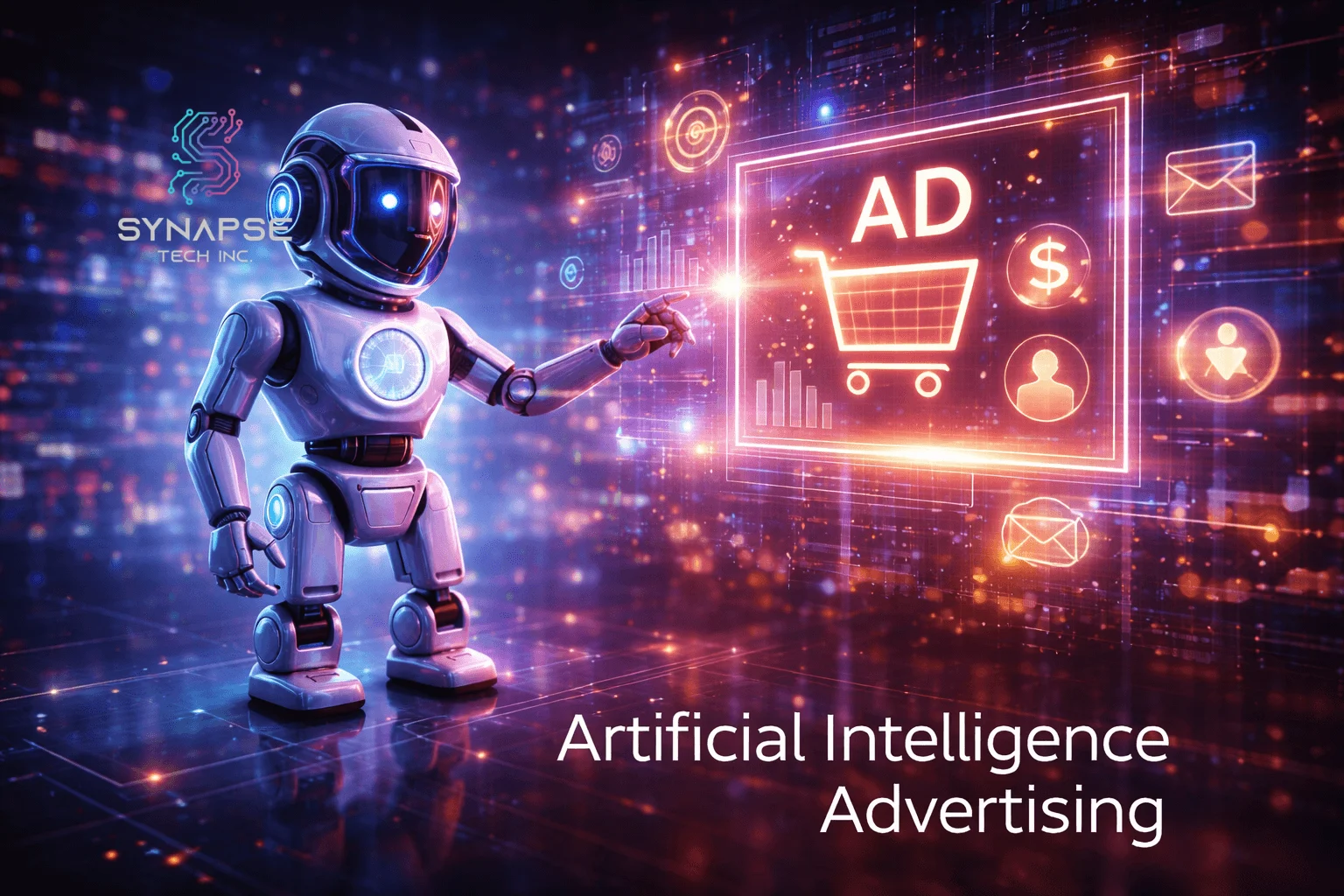
You launch a campaign at 9:00 a.m. By 9:03, it has rewritten itself based on engagement patterns your team hasn’t even seen yet. Headlines shift. Audiences reshuffle. Budget reallocates. Creative variants evolve in real time. This is the new state of artificial intelligence advertising.
Most CMOs think they understand what AI is doing in ads, such as automation, cheaper CPMs, and quicker optimizations. But artificial intelligence advertising has moved beyond optimization and started reshaping how brands interpret human intent.
Today, artificial intelligence advertising uses machine learning models and predictive algorithms to determine patterns across search, social media, programmatic displays, video campaigns, and other platforms.
It’s all about knowing what your customer wants before they do, where they’ll be looking for it, and when they are most likely to pull out their credit card. At Synapse Tech Inc., we’ve seen that the real secret isn’t just the automation — it’s the speed. While your competitors are still waiting for a weekly report, artificial intelligence advertising algorithms have already run a thousand tests and picked a winner.
What Actually is Artificial Intelligence Advertising?
Traditional advertising used to be a slow burn. You’d upload an image, pick some keywords, and hope for the best. Artificial intelligence advertising kills that model. It uses machine learning to analyze all those micro-signals, those small things like how long someone hovered over a button or what the weather is like in their zip code. It takes all this information and adjusts your bid price instantly. The End of “Set it and Forget it.”
Finding the Hidden Customer
Most tools just look for people who already bought from you. Whereas AI does the opposite, it looks for the people whom you missed. By analyzing billions of data points, it finds “lookalike” audiences that a human brain wouldn’t naturally connect. It’s not what you think, not at all demographic guessing, but rather a bit more detailed searching and classification of audiences.
How Artificial Intelligence Advertising Actually Functions?
Real-Time Decision Systems
Traditional campaigns collect data first and optimize later. Whereas when it comes to artificial intelligence advertising, it analyzes and adjusts simultaneously. Performance dips are corrected before they become expensive.
Predictive Audience Modeling
Instead of targeting based only on demographics, AI predicts purchase intent. It identifies behavioral similarities across users and reallocates spend toward higher-conversion clusters. Meta reports 32% higher ROAS from AI-powered dynamic creative, not because of better targeting, but because AI rebuilds personalized creative variants in real time.
Dynamic Creative Adaptation
AI can test hundreds of variations across headlines, visuals, and formats. The combinations that perform best scale automatically. Google and LinkedIn now use predicted intent audiences, allowing them to phase out the underperforming versions of ads.
Smart Budget Allocation
If one channel spikes in cost efficiency, AI shifts funds there instantly. And the best part is that no meetings are required. An Optimove survey found 78% of digital B2C marketers agree that AI significantly improves marketing performance.
This is not automation with rules, it’s actually adaptive decision-making.
Why Artificial Intelligence Advertising Adoption Is Accelerating?
Artificial intelligence advertising is growing because the economics demand it.
The numbers don’t lie, and yes, we’ve officially moved past the experimental phase of AI. The global AI marketing market has already surged past the $20 billion mark and is sprinting toward $82 billion by 2030 with a growth rate of over 26% every single year. On the other hand, McKinsey reports that organizations using AI in marketing and sales see revenue increases of 10–20% on average.
While a human team is still debating a single font choice, artificial intelligence-powered systems are testing a thousand different ad variations in the time it takes you to finish your coffee.
In 2026, the gap between the AI-haves and AI-have-nots isn’t just a slight edge…it’s a chasm.
Case Study Leaders Shouldn’t Ignore
We’ve seen this change the trajectory for brands that felt they had hit a “ceiling.” One e-commerce store was stuck at a $45 acquisition cost. By moving to an artificial intelligence advertising and intelligence-driven bidding system, they dropped that to $19 in less than two months. The owner told us, “I stopped being a data scientist and went back to being a CEO.”
Why Artificial Intelligence Advertising Is Becoming the New Standard?
The data is clear… Artificial intelligence advertising is no longer an emerging trend. It is the operating system behind modern performance marketing. Companies adopting it are seeing faster learning cycles, sharper targeting, stronger creative performance, and lower CAC.
Forward-thinking companies like Synapse Tech Inc. are already building in this direction. By embedding artificial intelligence advertising capabilities into platforms and offering intelligent solutions for recruitment, customer support, advertising, and enterprise growth, it redefines how organizations attract, engage, and convert audiences.
FAQs
Which AI is best for advertising?
It depends on what you’re trying to fix. If your ads look boring, AdCreative.ai is great for cranking out fresh visuals. If your problem is “where do I spend my money?”, tools like Madgicx or specialized systems at Synapse Tech Inc. are better because they handle the actual budget strategy.
Can artificial intelligence help with advertising?
Look, the reality is that trying to compete without AI right now is a losing game. It’s essentially your ‘unfair advantage’ in three big ways: speed, precision, and budget protection. Instead of crossing your fingers and hoping a campaign works, you’re using data to predict exactly what will convert before you even spend a dollar. It moves you out of the ‘guessing business’ and into the ‘results business.
Which are the top 5 AI tools?
Based on current adoption and performance, the top five for 2026 are:
- Claude: For high-level strategy and natural-sounding ad copy.
- AdCreative.ai: For generating thousands of conversion-focused visual assets.
- Jasper: For maintaining a consistent “Brand Voice” across all ad channels.
- Synthesia / HeyGen: For creating professional video ads using AI avatars.
- Cometly: For AI-powered attribution (tracking exactly which ad led to a sale).
Which AI tool is best for Google ads?
For Google specifically, Groas and Adsroid are the ones to watch in 2026. They operate with high autonomy, meaning they don’t just give you tips; they actually jump into your account and move the money around for you. They’re built to navigate Google’s complex bidding wars, so you don’t have to.