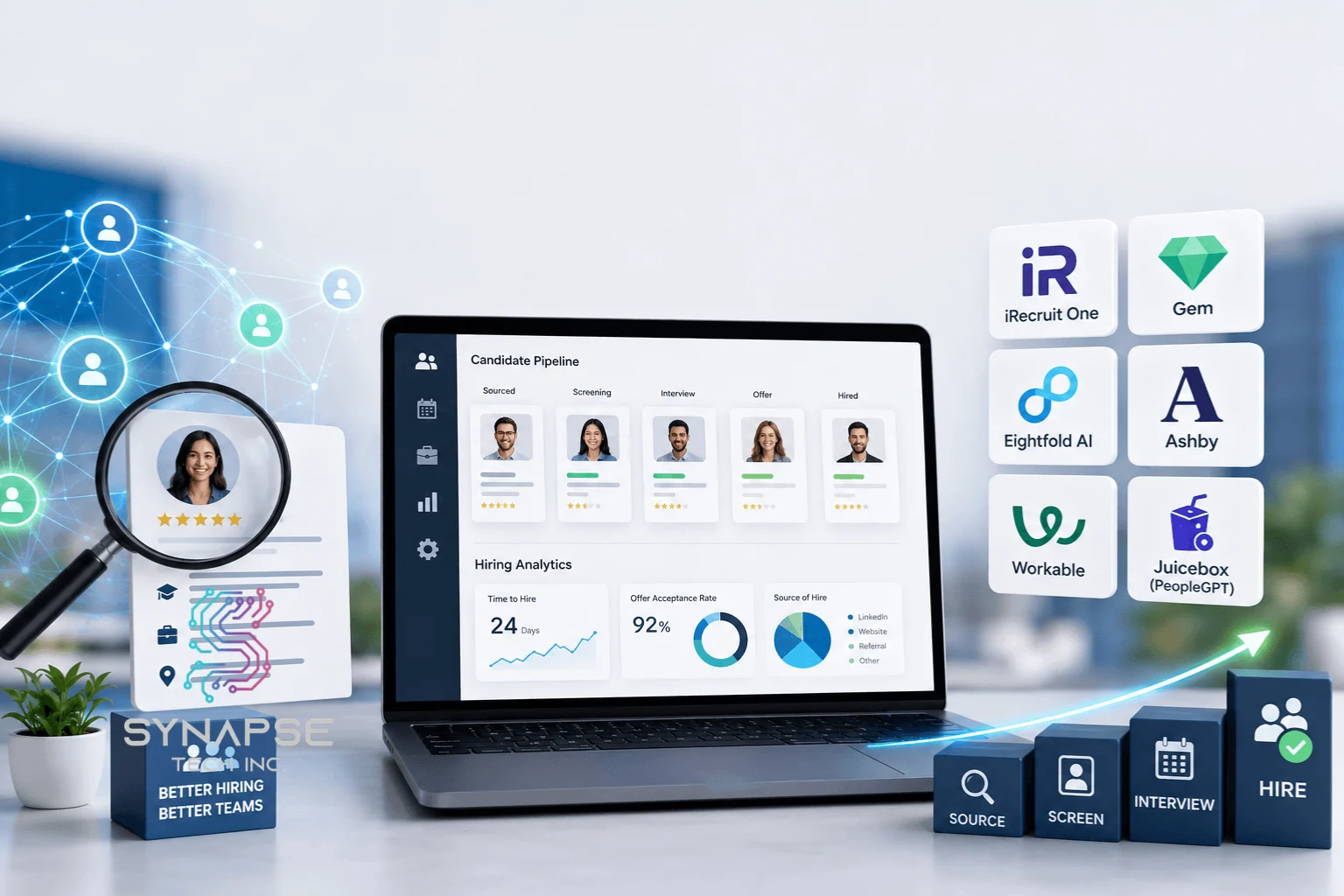
The best recruiting tools aren’t just tools; they’re the key to better hires. Recruiting tools are software that assist in sourcing, tracking, assessing, and hiring candidates in a quicker and more efficient way than ever before. They do the grunt work for you, find you better candidates, and stop your hiring process from spiralling out of control.
But the thing hiring managers don’t want you to know is that most companies are using spreadsheets and intuition to manage their hiring. And it’s costing them. The Society for Human Resource Management estimates the cost of a bad hire to be as high as 50% of the first-year salary.
If you’re ready to fix that, this guide is for you. We’ll explain how recruiting tools change the game in three ways, introduce you to the six best recruiting tools currently available, and explain how to choose the right one for you.
3 Reasons the Best Recruiting Tools Outperform Manual Hiring
They slash your time to hire. SHRM says it takes an average of 44 days to fill a job. The right applicant tracking system can help you cut this time to hire in half by automating screening, interviews, and reminders – all the things that take up your time.
They help you find candidates you’d otherwise miss. Most great candidates aren’t actively applying. They’re passive. AI-powered sourcing tools comb through LinkedIn, GitHub, and many other sites to find candidates you might never have considered for the role.
They make your hiring process consistent. At the beginning of my career, when I was sitting in on interview panels, I noticed each manager did things differently. Some used scorecards, others didn’t. Some responded to candidates in a day, others in weeks. Best Recruiting tools provide a framework to eliminate unconscious bias and keep everyone involved on the same page, which helps to make better decisions and provide a better candidate experience.
6 Best Recruiting Tools You Need To Attract Top Talent
This guide is written for HR leaders, talent acquisition teams, and business owners who are serious about hiring smarter — not just faster:
iRecruit One
iRecruit One is an AI-driven platform for hiring that Synapse developed – it’s more than just an ATS. It employs semantic intelligence to automate the entire hiring cycle – from inbox to interview – within your workflow.
Best For: Mid-to-large companies that employ large numbers of staff and want a quick, less-biased, and audit-friendly hiring process.
It stands out for its level of automation. It automatically imports CVs from email, conducts AI-powered video and voice interviews with sentiment analysis, and integrates with Google and Outlook – all without human intervention. It also integrates with existing HRMS systems such as Workday and SAP to reduce the time to hire by 70%.
Downside: For small or low-volume hiring companies, this enterprise-level platform may be too sophisticated for your needs.
Gem
Gem is a talent engagement platform that integrates with your ATS to create a recruiting CRM. It aims to help you nurture passive candidates.
Best For: Recruiters at fast-growing companies that focus on outbound recruiting and candidate pipeline building.
The analytics in Gem are great. You can track exactly where candidates are falling out of your pipeline, the best messages to send, and your pipeline’s health.
Downside: However, Gem works best when paired with an existing ATS. Unless you have one, you’ll need to factor in the cost of two.
Eightfold AI
Eightfold AI is an AI-powered tool that matches candidates to jobs based on skills and potential, rather than keywords. It’s one of the more advanced platforms.
Best For: Large organizations that hire large numbers of people and need AI to help with screening and matching.
Say you’re a retailer hiring thousands of seasonal workers – Eightfold could help you process their applications in minutes instead of days. Eightfold also has internal mobility tools so you can reallocate talent instead of hiring.
Downside: It’s too complex and too pricey for small companies. It’s built for scale.
Ashby
Ashby is an all-in-one recruiting platform that combines an ATS, scheduling, analytics, and CRM functionality into a single, beautifully designed tool.
Best For: Fast-growing startups and mid-market companies looking for a platform to manage their entire HR process.
Like Gem, Ashby’s reporting is top-notch. But unlike Gem, this is all in one platform: from sourcing candidates to scheduling meetings, managing the pipeline, and beyond. No jumping back and forth between five systems to advance a candidate.
Downside: Some users have reported that it can take a little time to set up the system. Allow time for setup.
Workable
Workable is one of the most popular of the best recruiting tools for its all-in-one approach. It’s great for posting jobs, sourcing, interviewing, and making offers.
Best For: Businesses of all sizes seeking a stable, powerful solution without enterprise features and costs.
Workable automatically sends your job listings to 200+ job boards. This saves hours on each new job position. And it comes with a decent mobile app, which is important when you’re on the go.
Downside: Workable’s AI sourcing is good, but not as cutting-edge as some sourcing platforms (like Gem or Eightfold).
Juicebox (PeopleGPT)
Juicebox (aka PeopleGPT) is an AI-driven candidate sourcing platform that allows you to search for candidates using natural language, like asking Google to find you a job candidate.
Best For: Sourcers and recruiters looking to find a needle in a haystack quickly without having to construct a long and complicated search.
First, the idea is a bit different from the others here. You search for “senior product designer in Austin with fintech experience,” and Juicebox takes care of the rest. It’s quick, easy, and reasonably accurate.
Downside: It’s mainly a sourcing platform. You’ll need an ATS to keep track of your applicants.
Conclusion
In short, the best recruiting software doesn’t just save time – it makes the entire hiring process more intelligent, efficient, and less bureaucratic for both you and your candidates.
If you’re a small company starting out, Workable and iRecruit One are easy to use and good value. If you’re growing rapidly, Ashby or Gem are great choices. If you want to reach out to passive candidates, try Juicebox and Eightfold AI.
Read More: 5 Best Candidate Sourcing Software to Find Top Talent Faster (2026 Guide)
So, when it comes to the best recruiting tools, it all comes down to where you are today – and where you want to be. Pick the tool that matches your stage of growth, train your recruiters, and start creating the hiring process your company deserves.
FAQs
Are recruitment tools the same as an ATS?
Not exactly. An Applicant Tracking System (ATS) is one of many types of recruiting tools, designed specifically to track candidates in the hiring process. Recruiting tools encompass sourcing platforms, CRMs, scheduling, and analytics platforms – many of which are used in conjunction with an ATS.
How can small businesses benefit from recruiting tools?
Small businesses can’t always afford a dedicated HR team, so recruiting tools help. They save money on advertising, streamline candidate information, and accelerate hiring communications – allowing a hiring team of two to do more than a team of ten.
What is the best type of recruiting tool for a small business?
Finally, for small businesses, an integrated system like Workable or iRecruit One is the best option. They’re cost-effective, simple to install, and provide the essential functions without confusing a small team with advanced bells and whistles they won’t need.