
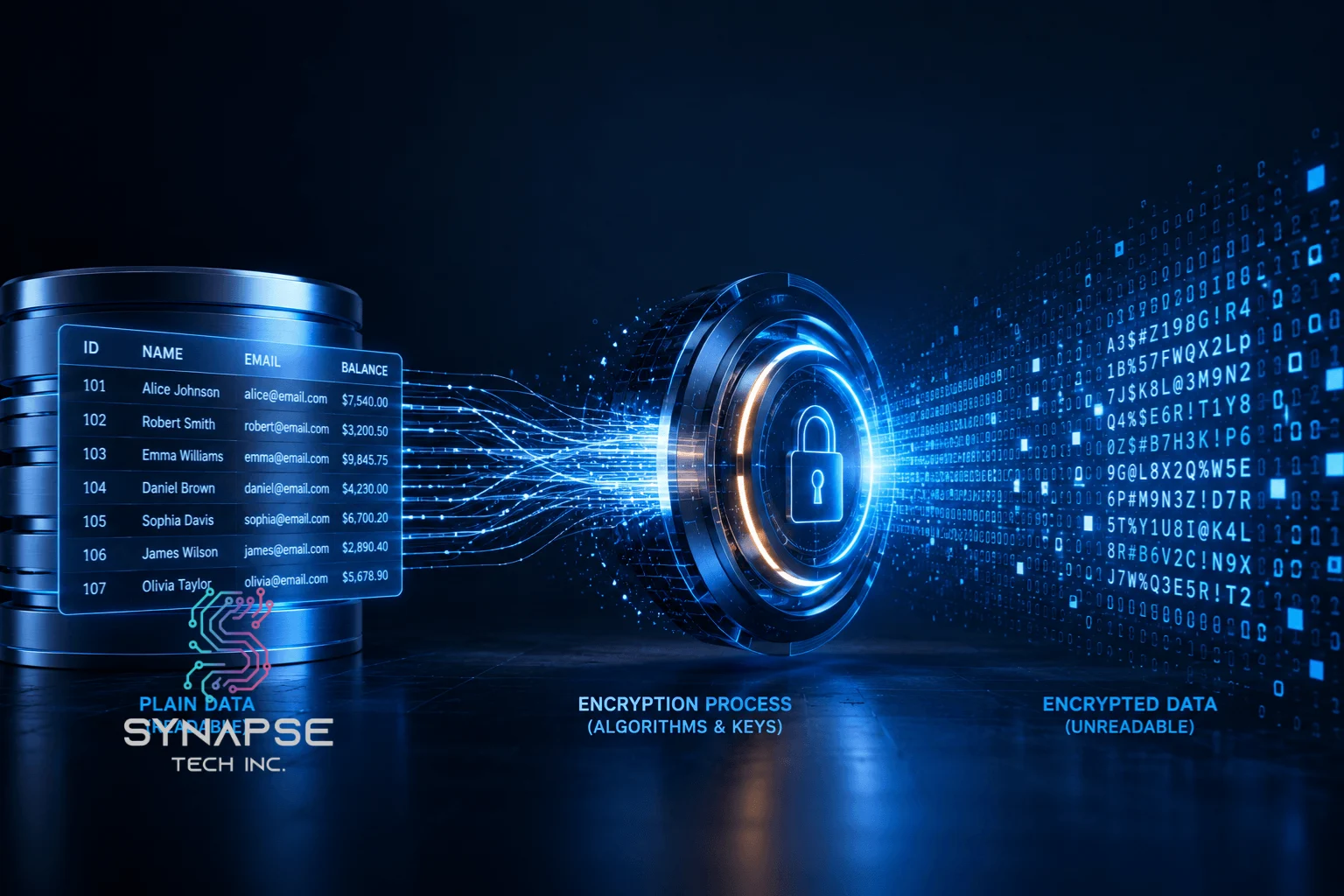
The use of database encryption methods is no longer an option, but a requirement for any organization that is serious about data security. Businesses have mountains of sensitive information stored daily: Customer records, financial data, health information, and login credentials. And, each day, that data is a target.
IBM reported that the cost of a data breach in 2024 averaged $4.88 million. However, a substantial number of hacks involve data that was not initially encrypted. That’s a priority issue.
In this guide, we’ll detail the essential advantages of database encryption, its mechanics, and seven of the most crucial database encryption methods you should be aware of if you want to safeguard your organization’s most sensitive data.
3 Powerful Benefits Of Database Encryption Methods
Avoid Security Attacks
Encrypted data cannot be read by anybody without the right decryption key. Implementing the right database encryption methods ensures encryption remains your last line of defense — one that holds even when everything else fails.
Protecting Sensitive Data
Regardless of the type of data you have, encryption keeps data secure, both at rest and in transit, and all along the way. It’s the difference between a breach and a catastrophe.
Compliance with Security Regulations
If you want to comply with GDPR, HIPAA, PCI-DSS, and other regulations, you need to have robust data protection measures.
What Is Database Encryption?
Database encryption involves using cryptographic algorithms to transform readable data into an unintelligible form. The original information can only be accessed by an authorised user who has the proper decryption key.
It’s not limited to large enterprises with huge data loads. Various database encryption methods are necessary for any organization that stores sensitive data, whether it’s a healthcare clinic, fintech startup, or e-commerce store. When collecting data, you are responsible for the protection of that data. That is how you meet that responsibility, via encryption.
How Does Database Encryption Work?
First, database encryption is achieved by using a cryptographic algorithm to encrypt your data prior to its storage. That algorithm encrypts the data into a format known as ciphertext, which is impenetrable (reads like gibberish) without its decryption key.
There are two main methods. Encryption at rest is used to secure your data stored in databases and file systems. In-transit encryption protects the data as it is transported across systems, applications, and users. The best security strategies are those that incorporate both.
Common Database Encryption Methods You Should Know
Below are the seven types of database encryption methods you might end up using to secure your data:
Advanced Encryption Standard (AES)
AES is the top standard of modern encryption – and for good reason. It can be used with 128-bit, 192-bit, and 256-bit keys, and AES-256 is almost impossible to break using today’s computers. It is fast, popular, and trusted by governments and financial bodies all over the world. For most organisations, AES-256 is the default starting point.
Triple Data Encryption Standard (TDES)
TDES re-encrypts the data thrice with the older DES algorithm, making it much stronger. It is, however, slower than AES and is being phased out in favor of newer database encryption methods. It is also not recommended for use in new banking and payment systems, but will be seen in legacy systems.
Rivest Shamir Adleman (RSA)
RSA is an asymmetric encryption technique where two keys are used, one public and one private. It is commonly implemented for data encryption during transmission or digital signatures, and not for bulk database encryption.
A mid-sized fintech company I worked with was moving sensitive customer financial data between applications without any encryption. If someone intercepted that traffic, they could easily read everything in plain text.
Once we identified the issue, we quickly locked things down by adding RSA encryption to every transfer point and AES-256 protection at the database level. In just three weeks, the company went from having a serious security risk to a fully encrypted end-to-end system. Thankfully, we caught the problem early — before the wrong person did.
Blowfish
Blowfish is a highly flexible and fast symmetric encryption algorithm suitable for applications that require high-speed encryption. It has been introduced to help with key lengths up to 448 bits and is of particular interest in the area of password hashing. Likewise, it is a good option for businesses that require quickness without compromising on security, although they are showing their age in comparison to newer options.
Twofish
Twofish is a replacement for Blowfish, and one of the winners of the original AES competition. It is available in 128, 192, and 256-bit keys, and it is very fast both in hardware and software. Twofish is definitely worth an organization’s consideration if they cannot get AES to perform like it’s supposed to.
Format-Preserving Encryption (FPE)
FPE is a specific type of encryption that encrypts the data without changing its format. That is, a 16-digit credit card number scrambled with FPE is still a 16-digit number. This makes it very useful for the payment system and legacy databases, where data format changes would necessitate extensive changes in infrastructure.
Elliptic Curve Cryptography (ECC)
Last but not least, ECC is among the more effective database encryption methods now available. It provides the same level of security as RSA, but with much smaller key sizes, which results in faster and less computationally intensive operation. The 256-bit ECC key is the same level of security as the 3072-bit RSA key, according to NIST. However, ECC is becoming a preferred method in mobile and IoT applications, and anywhere where processing power is constrained.
Case Study: How Synapse Helped An InsurTech Firm Cut Breach Response Time From 72 Hours To 4 Minutes?
A fast-growing InsurTech company dealing with personal and private information was flooded with security noise — more than 5,000 alerts per day. Their IT team manually looked at all of them. The result? A serious hole was left unpatched for 72 hours. It was impossible to reverse any of the damage by the time people realised.
Synapse developed its own Incident Response Platform, which integrated all logs from all firewalls, endpoints, and cloud systems into one smart platform. We integrated Opira AI as a virtual analyst, programmed with custom playbooks, and then got bots to quarantine infected servers without requiring any human approval.
The response time was cut from 72 hours to 4 minutes, core database breaches decreased by 73%, and the team could now enjoy 24/7 core protection without babysitting the alerts.
Conclusion
In conclusion, when it comes to choosing the right database encryption methods, the most interesting thing isn’t how complicated they are, but which one is appropriate to your data, your infrastructure, and your compliance needs. For most, AES-256 will be the default. Add RSA/ECC for data in transit and FPE when format consistency is required due to legacy systems.
Read More: Network Security Policy: 5 Things Every Business Must Include
The most common problem area concerns implementing encryption properly, and even a poorly configured implementation can leave actual gaps in security and leave you with a false sense of security. Synapse’s cybersecurity automation creates custom encryption structures around your unique infrastructure, managing key management, compliance reporting, and more.
In summary, reach out to Synapse now, and let’s create a strategy that you can trust in with encryption for your business.
FAQs
How does encryption ensure data integrity?
Encryption is used in conjunction with Hashing and Digital Signatures to ensure that data has not been corrupted. Changes in encrypted data are detected during decryption — right away, indicating the problem.
What regulations can affect an organization’s encryption strategy?
The most popular are GDPR, PCI-DSS, HIPAA, and ISO 27001. Which applies depends on your industry and location — and non-compliance is costly.
How does encryption work alongside AI or with recent AI developments?
AI is helping to identify irregular decryption behaviors, automate key updates, and identify weaknesses early on. As with all technology, the future of quantum computing is here and will require quantum-resistant encryption, which forward-thinking organizations are already preparing for.