By Zeeshan | Developer, Synapse Tech Inc.
Topic: Small Language Models, Large Language Models, enterprise AI, model selection
KEY TAKEAWAY In AI product development, the best model is not always the biggest one. The best model is the one that fits the problem, the deployment environment, and the business constraints.
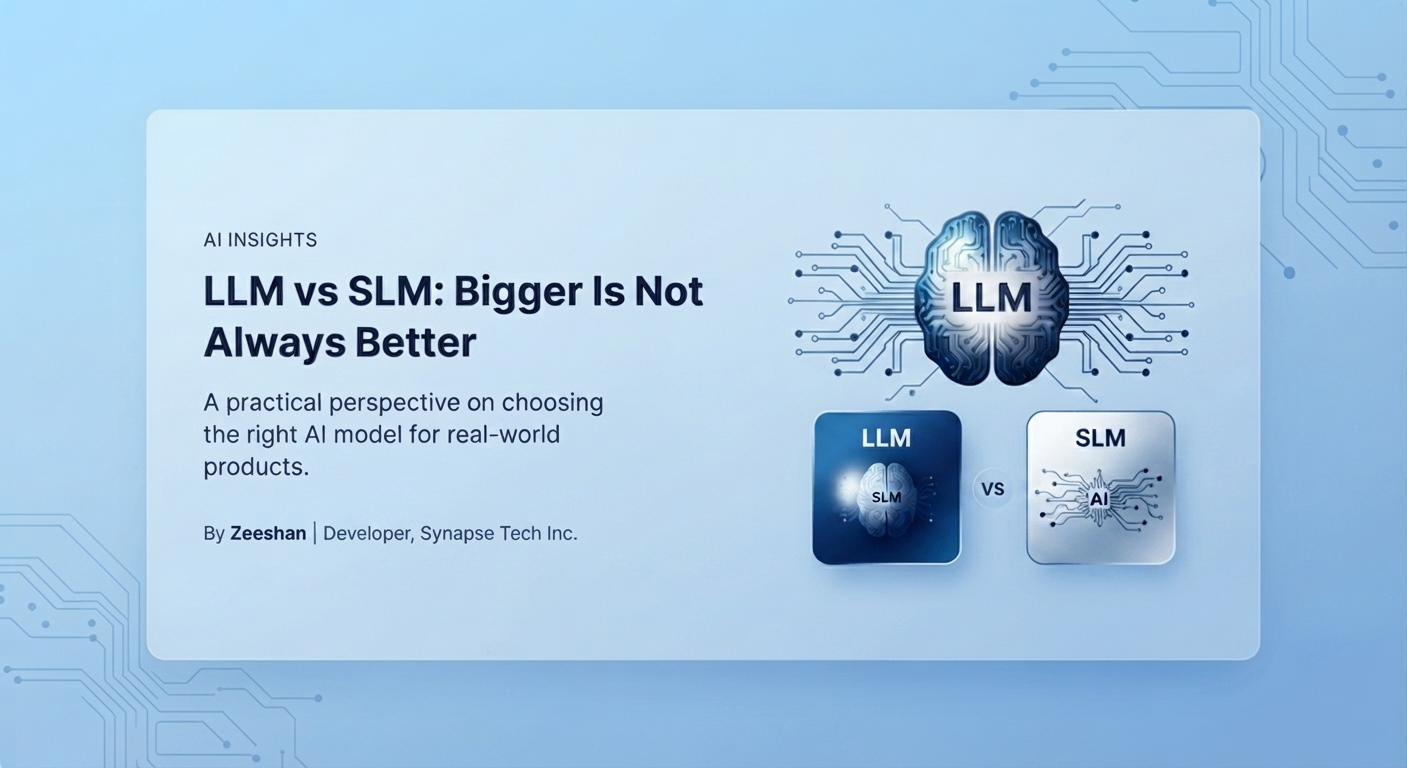
LLM vs SLM: Bigger Is Not Always Better
A practical perspective from Synapse Tech Inc. on choosing the right AI model for real-world products.
Why the “bigger model” assumption needs a second look
For a long time, the default assumption in AI has been simple: a bigger model should produce better results. To an extent, that belief is understandable. Larger models often perform better across a wider range of tasks, sound more capable in conversation, and dominate many public benchmarks.
But while working with Small Language Models (SLMs), I have learned that model size is not the same as product practicality. A model may be powerful in theory, but the real question is whether it is the right fit for the problem, the deployment environment, and the business constraints.
If the answer is always “use the largest model available,” we risk over-engineering solutions that could have been faster, cheaper, and easier to control with a smaller and more focused model.
A simple way to think about it
Imagine someone owns a sports car but only needs to travel 300 meters to meet a friend around the block. Can the sports car do it? Of course. But would using it for such a short distance be excessive and wasteful? Most people would say yes.
The same logic applies to AI model selection. Why use something much larger, heavier, and more resource-intensive when the actual task is small, narrow, and well-defined? This is where the idea of an SLM starts to make sense.
What makes Small Language Models practical
Small Language Models are built around a practical trade-off. They are designed to use fewer resources, cost less to run, and respond faster, while still handling focused tasks effectively.
When they are paired with the right domain knowledge, retrieval setup, fine-tuning strategy, or system design, SLMs can become a much more sensible choice than a large general-purpose model for specific use cases.
This does not mean smaller models are always the better choice. It means the decision should be based on the job the AI system is expected to perform.
Where Large Language Models still win
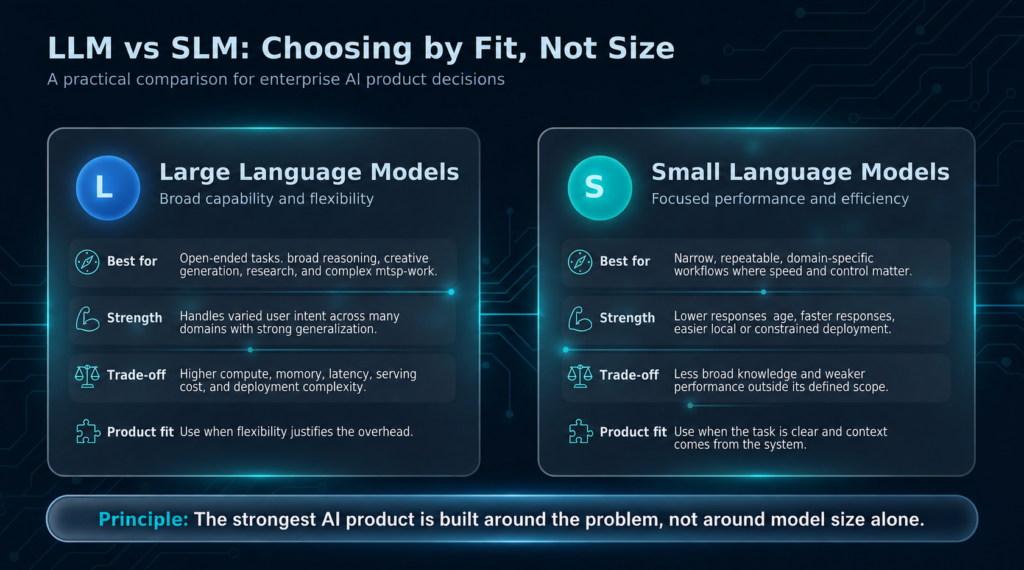
Large Language Models are strongest when the task is broad, open-ended, and difficult to predict in advance. Their biggest advantage is not only raw size, but also the range of knowledge and generalization they bring across many different domains, tones, and problem types.
That makes LLMs especially useful for research-heavy tasks, complex reasoning, creative generation, multi-step problem solving, and situations where the user’s intent may vary widely from one prompt to the next. In other words, LLMs perform best when a system needs flexibility more than specialization.
The same thing that makes them powerful is also what makes them expensive to operate. Because they are built to handle a massive variety of use cases, they require more memory, more compute, and usually more serving infrastructure.
At small scale, that may be acceptable. But as usage grows, cost, latency, and deployment complexity can become real bottlenecks. LLMs are not “bad” for product use. Far from it. They are simply best suited for situations where broad capability is worth the additional operational overhead.
Where Small Language Models shine
Small Language Models shine when the scope of the problem is limited, well-defined, and tied to a narrower set of tasks. In those situations, the goal is usually not to build a model that can talk about everything. The goal is to build a model that can do a specific job reliably, efficiently, and at lower cost.
Instead of carrying the full overhead of a large general-purpose model, SLMs can be used for focused assistants, private enterprise workflows, offline enterprise deployments, on-device mobile applications, and domain-specific products where speed and resource efficiency matter more than broad generalization.
In many business cases, the model does not need to know everything about the world. It only needs to perform well inside a particular business context.
That is why teams often start with a smaller base model and then adapt it through fine-tuning, retrieval, or system-level grounding around a specific product or domain. The result is a system that is lighter, cheaper to serve, easier to deploy locally, and often more practical for real product environments than a much larger model would be.
A practical model-selection view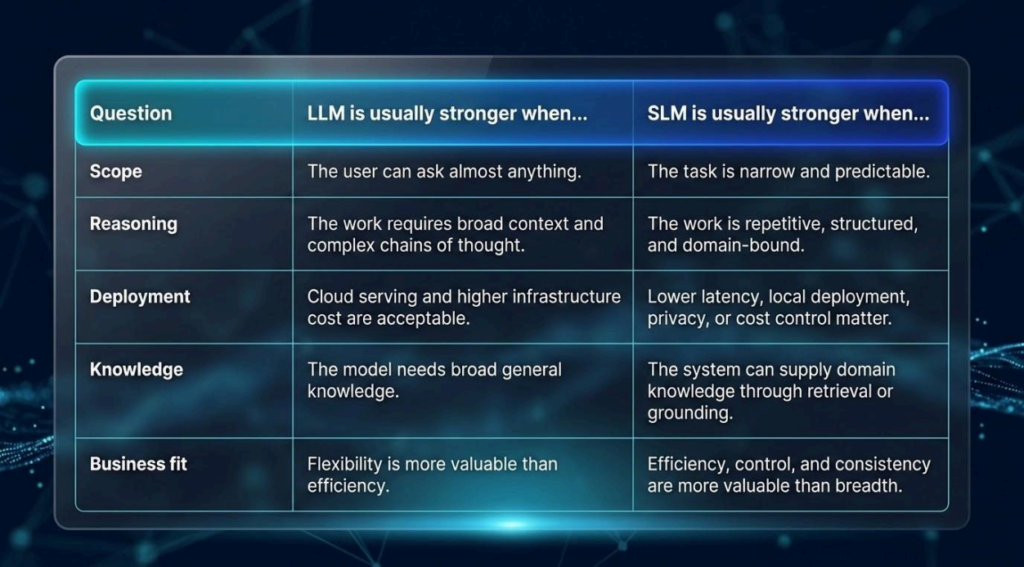
A good system is not built on model size alone
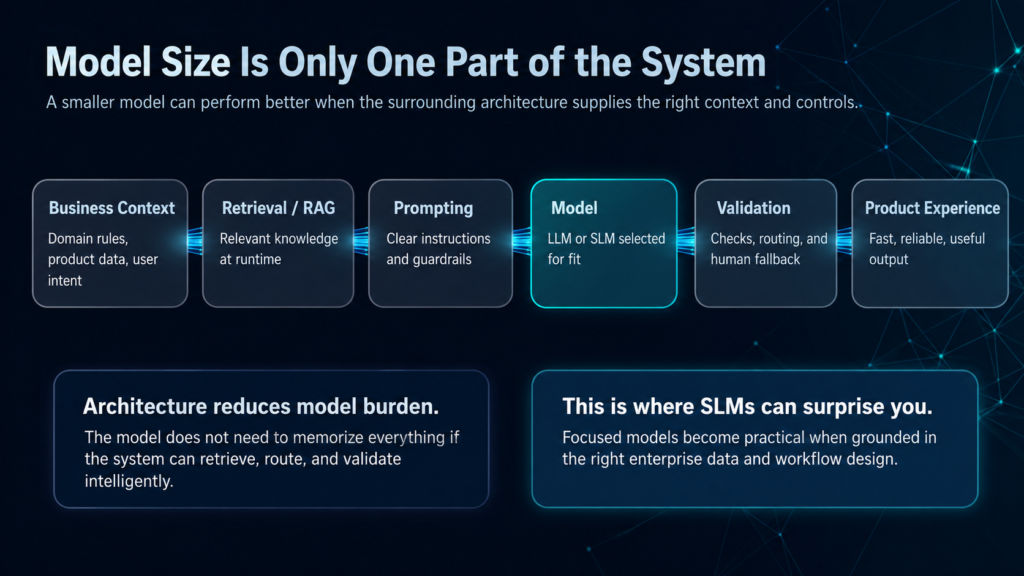
In real-world applications, the model is only one part of the final experience. The quality of the result also depends on how the surrounding system is designed.
That surrounding system may include retrieving the right information at runtime, grounding the model in domain-specific context, shaping prompts carefully, adding validation, and routing responses through the right workflow.
This is an important reason why smaller models can often perform better than expected. They do not need to store every piece of knowledge internally if the system around them can supply the right information at the right time.
In that sense, the real strength of an AI product does not come only from choosing the biggest model available. It comes from building an architecture that allows the chosen model to work effectively within the constraints of the task.
The real decision: fit the model to the problem
In the end, the real question is not whether LLMs are better than SLMs, or whether SLMs are better than LLMs. The better question is: which model is more appropriate for the problem being solved?
Large Language Models are incredibly powerful when flexibility, broad reasoning, and generalization are required. But that power comes with higher cost, higher latency, and heavier infrastructure demands.
Small Language Models, on the other hand, often make more sense when the task is narrow, the environment is constrained, or the product demands efficiency, privacy, and control.
FINAL THOUGHT Bigger is not always better. In practice, the best model is not the largest one available, but the one that delivers the right intelligence with the least unnecessary weight.
How this connects to our work at Synapse Tech Inc.
At Synapse Tech Inc., our focus is not just to experiment with trending technology, but to understand how it can be applied in practical, reliable, and business-ready ways. Working with SLMs has reinforced an important lesson: successful AI solutions are not built by chasing model size alone.
They are built by understanding the business problem, selecting the right architecture, grounding the system in relevant knowledge, and balancing performance with cost, speed, privacy, and maintainability.
That is the mindset we bring to AI, automation, cloud platforms, and enterprise software solutions. The goal is not simply to use advanced technology. The goal is to make advanced technology useful.
Author and Company Notes
Author Bio
Zeeshan is a developer at Synapse Tech Inc., where he works on practical AI systems, model experimentation, and implementation approaches for real-world business use cases.
About Synapse Tech Inc.
Synapse Tech Inc. builds technology solutions across AI, automation, cloud platforms, and enterprise software systems. The company helps organizations adopt modern technologies in practical, scalable, and business-focused ways. Learn more at www.synapsetechinc.com