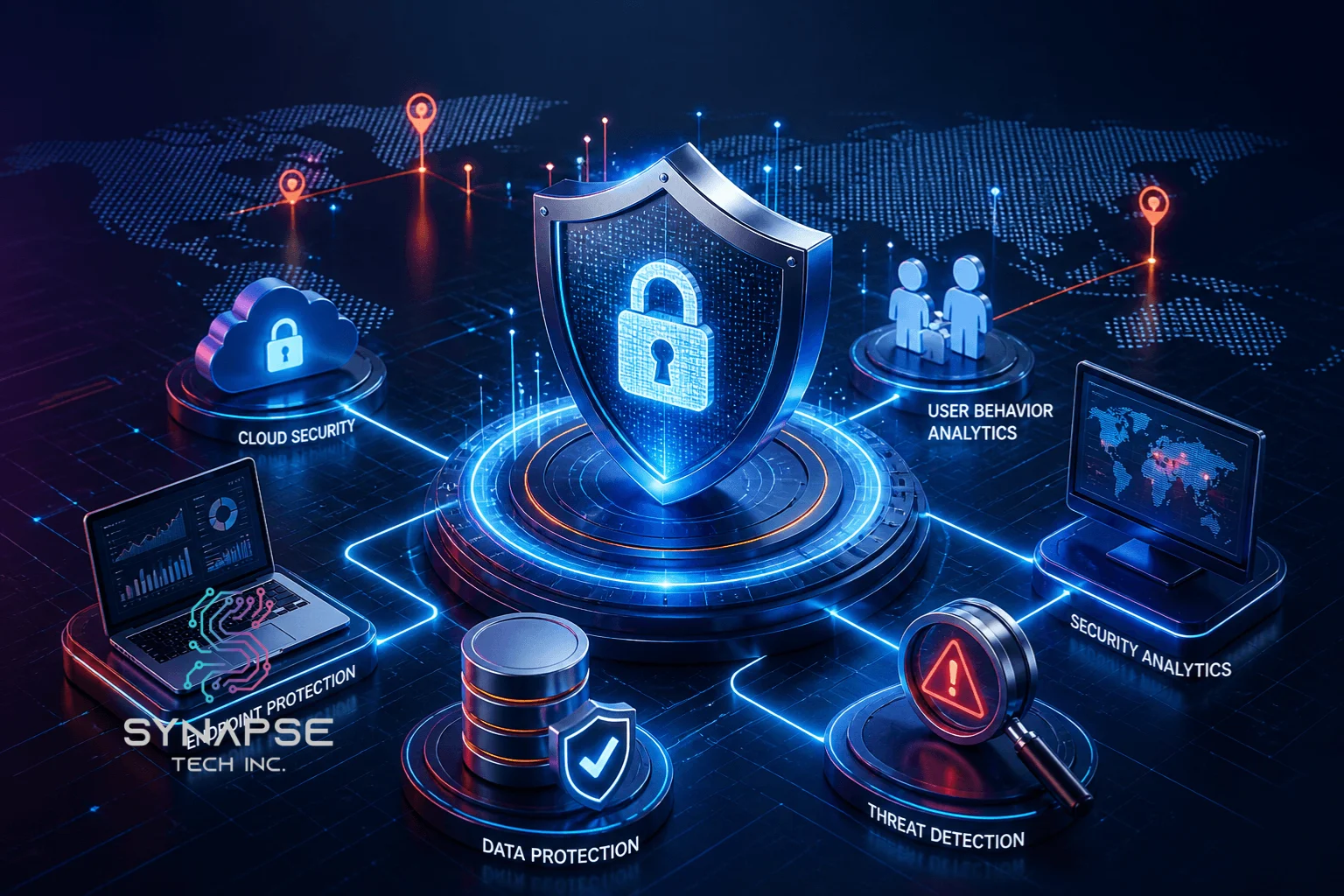
Security analytics isn’t just another buzzword in the cybersecurity world — it’s the smartest investment your business can make right now. Cyber threats are changing more rapidly than ever before, and conventional defenses are no longer cutting it.
There is a lot at stake. The Verizon 2024 Data Breach Investigations Report indicates that 68% of breaches had a human factor involved – i.e., your people and processes are as susceptible to breaches as your technology. In the meantime, Gartner forecasts that by 2026, organizations that invest in security based on analytics will lower the impact of breaches by half. That is no small margin – that is between survival and closure.
This article will discuss what security analytics is, the fundamental elements that drive it, why it can no longer be ignored by your organization, and where it is producing the greatest effect. Whether you are a business owner, IT manager, or security professional, this one is for you.
What Is Security Analytics?
Security analytics is the act of gathering, evaluating, and understanding information throughout your IT landscape to find and react to attacks. It integrates machine learning, behavioral analysis, and real-time monitoring to provide a clear view of what is happening in your network.
Imagine it as a 24/7 security operation center – but one that runs on data and automation. Instead of waiting for something to go wrong, it spots danger before it becomes a disaster.
Whether you are in financial services, healthcare, e-commerce, or SaaS, this is built for you. Similarly, IT managers, security operations teams, compliance officers, and business owners managing sensitive customer data all stand to benefit. To be honest, if you are an organization that lives online in any capacity, security analytics should not be optional; it should be a necessity.
The Core Components Powering Security Analytics
Security analytics isn’t a single tool, but a pipeline of capabilities that collaborate with each other.
- Data Collection: It all starts with data. Logs, network traffic, user behavior, endpoint activity – all of it is pulled into a central system. The more detailed the information, the more precise the analysis.
- Analysis: Raw data, in itself, is meaningless. This is where machine learning and statistical models play their role, finding patterns and anomalies that human analysts may overlook.
- Threat Detection: When anomalies have been marked, they are compared by the system to the known threat intelligence. An example is a strange attempt at logging in by a foreign IP at 3 a.m., which will be flagged at once.
- Response to Incidents: Lastly, security analytics does not merely detect; it takes action. Real-time responses can be automated to isolate impacted systems, revoke access, and warn your team, reducing response times significantly.
Why Your Organization Can’t Afford to Ignore Security Analytics?
Threat Visibility
What you cannot see, you cannot defend. Security analytics provides end-to-end visibility in your entire environment: cloud, on-premise, and hybrid.
Risk Awareness
It brings forward risks prior to them becoming an incident. Rather than responding to breaches, you are actively controlling exposure throughout your systems.
Alert Reduction
The number of alerts is overwhelming security teams. Nevertheless, security analytics removes the noise and focuses on what matters the most, which considerably decreases the alert fatigue. Ponemon Institute notes that security teams are getting an average of 11,000 alerts daily – and more than half do not receive an investigation.
Decision Clarity
I’ve seen security teams freeze during incidents simply because they had too much data and no context. Analytics changes that — it gives decision-makers clear, actionable intelligence fast.
I once consulted for a team with a solid security stack — firewalls, endpoint protection, a fully deployed SIEM. On paper, they were set. But when a real incident hit, they froze. Alerts firing everywhere, logs were piling up, and no one could tell what actually needed attention first. They had plenty of data. What they were missing was context.
I didn’t overhaul their setup. I helped them layer behavioral analytics on top of what they already had, built a triage workflow their analysts could actually follow under pressure, and showed them how to cut through the noise fast.
The result? Response time dropped from 6 hours to under 45 minutes. Same team, same tools, just finally working smarter.
More technology was never the answer. A clearer picture of what’s happening and why — that’s what changed everything.
Operational Scale
Secondly, as your business expands, so does your attack surface. Security analytics is scalable to millions of endpoints, without requiring doubling your staff.
Environmental Complexity
The current IT landscapes are chaotic – there are multiple clouds, remote employees, and third-party providers. Security analytics simplifies all that and provides a single view.
Incident Readiness
Equally, a survey conducted by SANS Institute revealed that organizations that employed advanced security analytics identified threats 60 times faster than conventional ones. Time is of the essence – each minute that an attacker remains undetected is a minute of damage.
Where Security Analytics Delivers the Most Impact?
Use Case |
Impact Of Security Analytics |
| Threat Detection | It detects known and unknown threats dynamically by examining patterns of behavior on your whole network – not just the perimeter. |
| Insider Activity | It is not always the outside that is threatening. Security analytics helps to track user activity to indicate suspicious access patterns, data downloads, or privilege escalations. |
| Incident Investigation | In a situation where something indeed goes wrong, analytics will significantly accelerate forensic investigation. You receive a timeline of events with context, not a litter of a log. |
| Account Compromise | The credentials that are compromised are the cause of a staggering number of breaches. Analytics identifies unusual login activity and alerts you before hackers can inflict severe harm. |
| Cloud Monitoring | With the increasing adoption of the cloud, security analytics continue to monitor cloud settings, access controls, and unusual activity in AWS, Azure, and GCP. |
| Risk Assessment | Lastly, it constantly rates and ranks risks in your environment, so your team is never in the dark about where to start. |
How Synapse Helped A Company Scale Compliance Without Scaling Headcount?
Growth is exciting — until your compliance team is drowning in it. That’s exactly where this neo-bank found itself when it hit 1 million users. A 340% spike in lead volume meant one thing: they couldn’t hire fast enough to keep up, and costs were climbing with every new signup.
The fix wasn’t more headcount. Synapse Tech built a Custom Compliance Middleware pulling data from global watchlists, social signals, and transaction history — all in one place. Opira AI then stepped in to handle the heavy lifting, actually investigating flagged transactions rather than just alerting on them. Genuine risks got escalated with a full dossier ready for human review. Everything else got cleared automatically.
The outcome? Ten times the application throughput, 65% fewer false positives, and a 99.9% audit-ready documentation trail — without hiring a single extra compliance officer.
Conclusion
In conclusion, security analytics can help make cybersecurity a proactive approach rather than a reactive one. It provides you with visibility, speed, and intelligence that you can not achieve with traditional tools.
Simply put, the companies that invest in security analytics today will not be scrambling to recover tomorrow. The threat environment is not decelerating – and neither ought your protection.
Ready to put analytics to work for your business? Synapse’s cyber security automation gives you the always-on, intelligence-driven defense your organization needs. So, contact us today to make it a part of your organization!
FAQs
What is the main purpose of security analytics?
Security analytics are primarily aimed at identifying, analyzing, and reacting to cybersecurity threats in real-time. It involves data analysis and machine learning to detect patterns and anomalies to point to the possible attack- before it can inflict significant harm.
Does your company need security analytics?
Yes, you need it, so long as your business involves sensitive data, and is in the cloud or has more than a few users. Cyber threats are not selective in terms of the size of companies, and manual monitoring cannot keep up with the attacks of today.
How is security analytics different from security monitoring?
Security monitoring is used to monitor real-time activities and provide alerts. Security analytics do not stop at that; they process that data, discern patterns over time, and give context-driven insights that allow you to know why a threat occurred, as well as what.