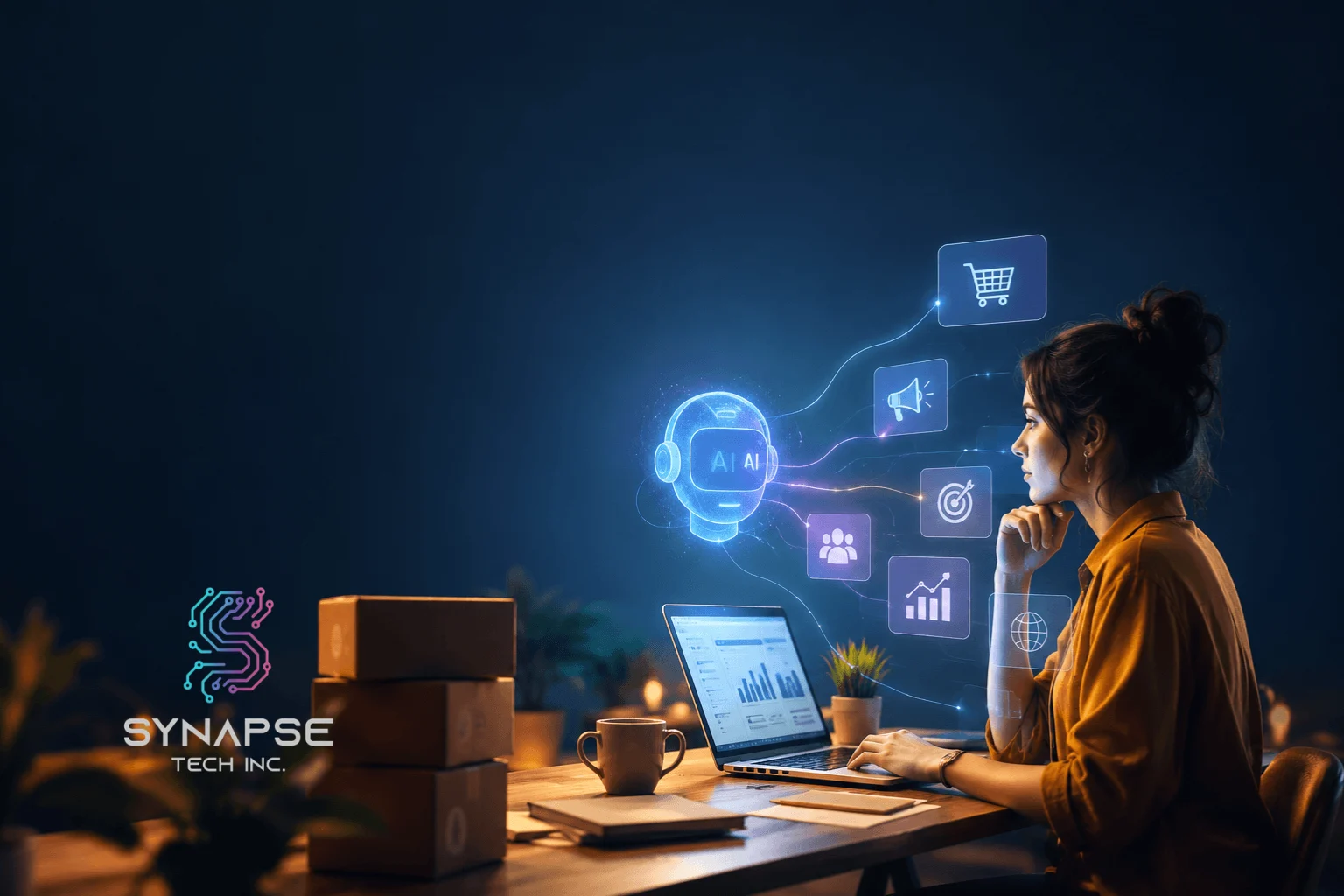
A small business using AI for marketing is something that has just started. It is not something reserved for big companies with large budgets and extensive data science teams anymore. It’s happening right now — at boutique agencies, coffee shops, and two-person e-commerce stores. And the businesses that are doing it are stealthily gaining the edge over the businesses that still cling to the outdated manual approach.
Businesses that leverage AI in marketing experience revenue growth of as much as 20% and cost reduction of as much as 30%, according to McKinsey. Those aren’t numbers that you can afford to ignore when operating on a lean budget.
We’ll explore the actual value of small business AI tools in marketing, the four key areas where AI offers the most competitive edge, and an easy step-by-step walkthrough to help you get started — even if you have no technical expertise.
Benefits Of A Small Business Using AI For Marketing
AI marketing tools aren’t just for tech companies or well-funded startups. They’re designed for the restaurant owner who doesn’t have a full marketing team, the freelance marketer developing a personal brand, and the e-commerce store that is playing against the juggernaut that’s nearly ten times their size. These tools were created for the marketer who sees the world as an uphill fight. Below are some of the benefits of a small business using AI for marketing.
You Can Gain A Competitive Advantage
First of all, your larger competitors have been using AI for years. The happy news is the tools have caught up — and small businesses can now experience the same options without the enterprise cost. The power of AI is the ability to personalize marketing on a large-scale level and make decisions informed by data, not intuition. This advantage grows with time.
You Can Boost Your Productivity And Efficiency
Next, consider just how much time your team devotes to repetitive activities, such as writing the captions, scheduling posts, drafting emails, etc. AI does all that, and more, in an instant. Salesforce states that AI-powered automation can save up to 6 hours per day for marketing teams. That time is shifted to strategy and customer relationships – the things that matter when growing a business.
You Can Make Smarter, Data-Driven Decisions
One of the key benefits of small business using AI for marketing is the enhanced ability to make informed decisions. Rather than taking a stab in the dark, AI can look at your performance and tell you where to invest your efforts. You no longer spend money on what you think is best, and you begin to spend money on what the data shows works.
4 Areas Where AI Can Give Your Small Business The Upper Hand
Create Your Personal Brand
Generate consistent, on-brand content across all channels — blog posts, LinkedIn updates, email newsletters, and more — with the help of AI. Trust is built with consistency, and consistency creates brands.
I worked with a small consulting firm that was barely showing up on LinkedIn — two posts a month, no consistency, no traction. We created an AI-driven content workflow for them that automated their entire content pipeline. They increased their posts from two per month to five times per week, without adding employees. In 90 days, the number of inbound inquiries had increased by a factor of three.
Advertise More Effectively
Likewise, AI-driven ad platforms automatically test ads, audiences, and bidding strategies, and then optimize your spend based on what converts. You won’t be speculating what the rating or price is. AI increases the effectiveness of each dollar.
Sell More And Retain Customers
AI customizes the entire customer journey, right from the first touchpoint to post-purchase follow-up. Personalized re-engagement emails and AI-powered chat support boost conversions and loyalty. It is five times as economical to keep a current customer as to attract a new customer. AI makes retaining a breeze.
Find And Hire The Right People
Last but not least, growth comes with recruiting — and recruiting the wrong person is costly. AI recruitment software filters candidates more quickly, mitigates bias, and identifies the most qualified candidates based on their skill sets, not intuition. It’s a big benefit for small businesses without a Human Resources team.
How You Can Get Started With AI in marketing?
Step 1: Identify Your Main Issues
A small business using AI for marketing needs to start by identifying its main problems without using any tools first. Is it actually content development? Ad performance? Customer retention? AI is most effective at solving a well-defined problem. List your top 3 marketing challenges; this is your roadmap.
Step 2: Look For The Right Tools
After solving the issue, match the appropriate solutions. This is where most small businesses falter — there’s a myriad of AI tools out there, and not every one of them is worth your time.
That’s where Synapse’s tailored AI solutions really come into play. Instead of getting an off-the-shelf tool that kind of fits your business, Synapse creates AI-driven marketing automation that’s designed to fit your workflows, your audience, and your goals.
Step 3: Start With A Small Pilot Project
Avoid doing everything automatically. Choose one area (email marketing, social content or ad optimization) and conduct a pilot there for 30-60 days, and then re-evaluate. Small wins give confidence and provide ammunition to prove success for expanding the rollout.
Step 4: Measure And Develop
AI is not a one-and-done approach. Analyze and evaluate the results every month, make changes to the inputs, and allow the system to learn from real-world feedback. Monitor key metrics such as cost per lead, conversion rate, and customer retention.
Case Study: How Synapse Helped A Small Food Business Boost Its ROI With a Custom Marketing Solution?
A small food business was spending money on social media ads and e-mail campaigns, but getting little return. No clear targeting, no automation, and no way to tell what was actually working. All the marketing decisions were made on a trial-and-error basis.
Synapse integrated and created a custom AI marketing system that automated their email sequences, optimized their ad targeting using actual purchase behavior, and all campaign data was brought together into a live dashboard.
Their cost per acquisition decreased by 40%, and ROI in marketing increased by 3x in 60 days. Turns out, the food was never the problem — the marketing was.
Conclusion
To sum up, a small business using AI for marketing isn’t about replacing your team or overhauling everything overnight. It’s all about eliminating friction and getting the most out of marketing dollars.
The companies that are thriving today don’t always have more resources or better products — they just use their resources more wisely. Synapse’s custom automation solutions are designed for small businesses that are looking for enterprise-level results without the enterprise-level complexity. Whether it’s intelligent ad optimization systems, AI-driven content workflows, or even AI-enabled customer journeys, Synapse keeps expanding as you do.
Read More: AI Content Creation in 2026: 7 Steps to Rank #1 on Google Faster
To sum up: If you’re truly looking at how AI marketing can help expand your small business, reach out to Synapse today to build something that truly moves the needle.
FAQs
Is AI too expensive for a small business?
Not anymore. The ROI on many AI marketing tools will likely pay off in a few months, and they usually charge a low monthly rate or are free to begin with. Custom solutions from Synapse are designed to grow as your budget grows; enterprise results don’t have to come at an enterprise cost.
Do I need to be a tech expert to use AI?
No. The majority of AI marketing tools are designed with easy-to-use user interfaces for non-technical users. Then, if you’re using Synapse, the hard work is done for you, so you can concentrate on the outcomes.
How will using AI in my business improve my visibility in AI search tools?
AI search platforms focus on authoritative, consistent, and relevant content. Creating quality content with AI at scale creates the sort of online footprint that attracts your target customers to your product or service.